

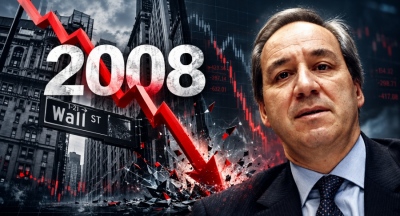
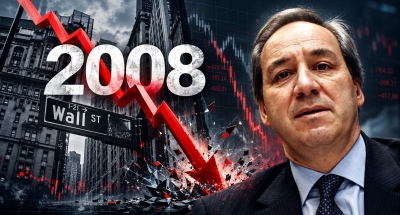
Sounding an alarm over the potential for fresh international financial turmoil, former Minister of Finance of Greece George Alogoskoufis released an analysis evoking memories of the 2008 economic shock. At the center of his analysis are three critical catalysts threatening to deregulate markets and spark a new "perfect storm." Specifically, according to Mr. Alogoskoufis, the current global economic climate displays alarming similarities to the period leading up to the 2008–2009 financial crisis. Elevated asset valuations, accumulated debt, intricate financial interconnections, and optimism surrounding artificial intelligence technology coexist alongside significant economic vulnerabilities. However, the differences are equally important, he notes.
The potential origins of a new crisis, the international environment, and the policy response margins have shifted. The question, therefore, is not merely whether 2008 will repeat itself, but whether we have understood the mechanisms that transform economic shocks and imbalances into systemic instability. As the former finance minister points out, prior to the previous crisis, the global economy seemed to have entered an era of perpetual prosperity. Growth was robust, international trade was expanding, and inflation across advanced economies remained relatively subdued. The so-called "Great Moderation" had bolstered the conviction that improved monetary policy and financial innovation were diminishing the risk of major fluctuations. In reality, this apparent stability encouraged increasingly risk-taking behavior. At the epicenter was the US housing market. Credit expansion, subprime mortgage lending, and securitization created a web of financial claims whose underlying risks were difficult to evaluate.
Distributing loans among multiple investors was thought to enhance safety. When housing prices plummeted, however, it became clear that risks were tightly correlated. Uncertainty regarding losses eroded trust, disrupted funding, and transmitted the crisis into the real economy. The first similarity to today is the market tendency to turn a plausible economic expectation into risky bets. Prior to 2008, the prevailing assumption was that home prices were unlikely to decline nationally. Today, artificial intelligence feeds expectations for substantial gains in productivity and corporate profitability. Its potential is significant, but neither the timeline for realizing these gains nor the distribution of benefits is guaranteed. A technological revolution can transform the economy while simultaneously generating overvalued investments.
Rising risk - Similarities
According to George Alogoskoufis, risk mounts when major capital expenditures rely on overly optimistic revenue forecasts and, in part, on borrowing. If expected profits are delayed, investment cutbacks, falling valuations, and lender losses may follow. The Bank for International Settlements has highlighted risks stemming from the concentration of investments in artificial intelligence and accompanying interdependencies. This does not prove that an AI bubble exists comparable to the housing bubble. It indicates, however, that technological optimism requires strict and systematic scrutiny. The second similarity involves leverage and opacity. Prior to 2008, risks were frequently concealed within complex financial products and off-balance-sheet bank activities. Today, investment funds, private credit firms, and other non-bank financial intermediaries play a larger role. Their expansion broadens funding sources but also creates interconnections that are not always transparent. Particularly in government bond markets, highly leveraged strategies reliant on continuous funding can intensify disruptions through forced asset sales. A third similarity is that the resilience of the real economy can generate a misleading sense of security. Growth, employment, and corporate profits do not fully expose the vulnerabilities of the financial system. Balance sheets can deteriorate rapidly even as economic activity continues to expand. The critical tipping point occurs when investors simultaneously question collateral values and counterparty solvency. Attempts to mitigate risk, while prudent for individual institutions, can then destabilize the entire system.
Differences
The most significant difference lies in where debt-related vulnerabilities are concentrated. In 2008, says George Alogoskoufis, the crisis originated primarily in private borrowing and bank exposure to the mortgage market. Today, high sovereign debt constitutes a central pillar of international economic fragility. Rising borrowing costs gradually burden state budgets as older debt is refinanced. Concurrently, spending demands for defense, infrastructure, the energy transition, and social protection intensify fiscal pressures. Because sovereign bonds are widely utilized as collateral, a disruption in these markets can ripple across the whole financial system. A second difference concerns institutional readiness. Post-2008 reforms strengthened bank supervision and established financial stability as a core policy priority. Authorities now possess the experience of the previous crisis and the interventions it rendered necessary. This represents an important advantage. However, it does not guarantee that new risks will be identified in time, particularly when emerging within non-bank institutions and markets distinct from those at the heart of the previous collapse.
The macroeconomic and geopolitical environment is also fundamentally different. Today, energy disruptions, military conflicts, and trade restrictions simultaneously impact output and price levels. International organizations project global growth around 2.9% in 2026 and 3.0% in 2027, highlighting persistent inflationary pressures and uncertainty. This picture combines economic resilience with weak momentum and successive supply shocks. It differs both from pre-2008 optimism and from the demand collapse that followed the outbreak of the previous crisis.
These conditions generate tougher dilemmas for economic policy. New financial turmoil would demand immediate liquidity provision, yet sticky inflation would restrict room for broad monetary easing. Safeguarding market functionality would need to be carefully separated from measures designed to stimulate aggregate demand. Correspondingly, high public debt renders large-scale fiscal interventions more costly. Geoeconomic fragmentation further complicates international coordination precisely when cross-border financial ties render international cooperation vital. Consequently, there are insufficient grounds to deem a repeat of 2008 likely.
There are, however, compelling reasons to avoid complacency. Priorities must include early identification of excessive leverage, enhancing transparency in financial interconnections, and restoring fiscal buffers. The lesson of the previous crisis is that stability demands continuous policy vigilance. The next crisis, if it erupts, may start in a different market but spread through the same familiar mechanisms: loss of confidence, funding dry-ups, and forced deleveraging, concludes George Alogoskoufis.
www.bankingnews.gr








Σχόλια αναγνωστών